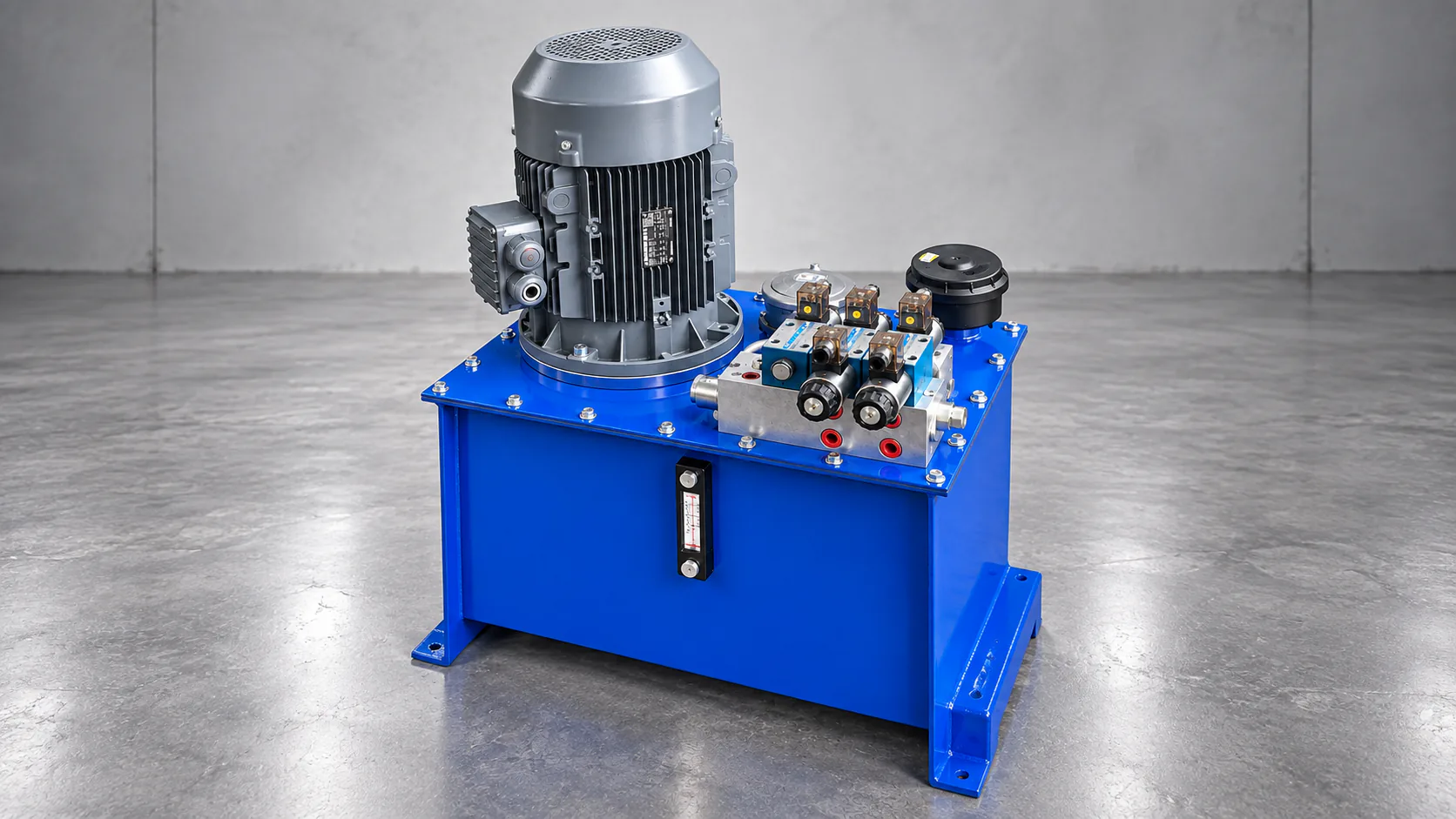
Hydraulic Units
Hydraulic Unit
Güleç Makina hydraulic power units for construction machinery are designed to supply the pressure and flow mobile machines require, and to operate cylinders and hydraulic motors safely.
Hydraulic power units used on construction machinery are engineered for high pressure, variable load, vibration, dust, mud, temperature changes, and severe field conditions.
Depending on the application, custom hydraulic power units can be built with electric-motor, diesel-engine, petrol-engine, or vehicle-PTO drive.
Let's Discuss Your ProjectCAD File AccessDrive systems
Electric-motor power units
Electric-motor hydraulic power units can be used on stationary or semi-mobile construction machinery.
Advantages:
- High efficiency
- Low maintenance
- Straightforward automation
- Low noise
- Suitable for indoor applications
Diesel-engine power units
Diesel-engine power units can be used in field applications where electrical power is not available.
These systems are an advantage in:
- Construction sites
- Mining
- Mobile maintenance equipment
- Road construction machines
- Remote field applications
These applications benefit from this drive.
PTO-driven power units
Mechanical power taken from a truck, tractor, or construction-machine engine can be transferred to the hydraulic pump through a PTO.
This arrangement is particularly suitable for:
- Dump systems
- Mobile cranes
- Municipal vehicles
- Agricultural machinery
- Truck-mounted equipment
It is well suited to these applications.
Oil tank
The hydraulic tank holds the system oil reserve and also helps the oil cool and air and particles separate out.
When sizing the tank, the following should be taken into account:
- Pump flow
- Total system oil volume
- Operating duration
- Thermal load
- Cylinder volumes
- Mobile application conditions
These factors should be taken into account.
Depending on the application, the tank can include:
- Filler cap
- Breather filter
- Level indicator
- Temperature indicator
- Suction filter
- Return filter
- Drain plug
- Cleaning cover
These features can be provided on the tank.
Filtration system
On construction machinery, hydraulic oil cleanliness is critical to system life.
Depending on the application, the power unit can use:
- Suction filter
- Pressure filter
- Return filter
- Offline filtration system
These filters can be used.
Suitable filtration:
- Extends pump life.
- Reduces valve failures.
- Protects cylinders and motors.
- Extends seal life.
- Raises system reliability.
Cooling system
On construction machinery that runs for long periods, hydraulic oil temperature can rise.
A rise in oil temperature can cause:
- Lower oil viscosity
- Shorter seal life
- Lower pump efficiency
- Faster oxidation
- Shorter system life
These effects can result from higher oil temperature.
Where the application requires it, the following can be used:
- Air-oil cooler
- Water-oil heat exchanger
- Oil cooler with electric fan
These coolers can be used.
Valve system
On construction-machinery power units, the valve assembly controls motion and safety.
Depending on the application, the following can be used:
- Directional control valves
- Pressure-relief valves
- Pressure-reducing valves
- Flow-control valves
- Check valves
- Pilot-operated check valves
- Counterbalance valves
- Load-holding valves
- Proportional valves
- Solenoid valves
These valves can be used.
Valves can be grouped on a separate manifold or inside a compact hydraulic block.
Mobile hydraulic applications
Power-unit design for mobile construction machinery has to meet conditions that differ from stationary industrial systems.
The design should take the following into account:
- Vibration
- Shock
- Operation on a slope
- Dust
- Mud
- Rain
- Outdoor temperature
- Compact installation space
- Vehicle movement
These conditions should be taken into account.
Connections, tank construction, pump mounting, and valve assemblies should therefore be designed for field conditions.
Pressure protection
Excess pressure in a hydraulic system can damage the pump, hoses, cylinders, and other components.
The system should therefore include a pressure-relief valve set to a suitable value.
The relief valve protects the hydraulic components by limiting the maximum permitted system pressure.
Load holding and safety
In lifting and mobile-machine applications it is important to prevent uncontrolled movement of the load.
Depending on the application, the following can be used:
- Pilot-operated check valve
- Counterbalance valve
- Hose-burst valve
- Overcenter valve
- Load-holding valve
These valves can be used.
On cranes, platforms, and lifting systems in particular, these valves are important for system safety.
Sensors and control systems
On modern construction machinery, the hydraulic power unit can work together with electronic systems.
Depending on the application, the following can be used:
- Pressure sensor
- Pressure switch
- Oil temperature sensor
- Oil level sensor
- Filter clogging sensor
- Flow sensor
- Position sensor
These sensors can be used.
Data from the sensors can be monitored through a PLC, a machine controller, or an operator panel.
Proportional and electronic control
Proportional hydraulic systems can be used on construction machinery that needs precise speed and force control.
With proportional valves, the following can be controlled electronically:
- Cylinder speed
- Hydraulic motor speed
- Pressure
- Flow rate
- Motion acceleration
These values can be controlled electronically.
This arrangement is an advantage on modern mobile machines that need precise, stepless motion.
Hoses and piping
For the power unit to operate correctly, hydraulic lines must be sized to a suitable diameter.
Incorrect pipe or hose diameters can cause:
- Pressure loss
- Heating
- Cavitation
- Noise
- Low system efficiency
These problems can occur.
Suction, pressure, and return lines should each be sized for the system flow.
Preventing cavitation
Insufficient oil supply in the pump suction line can cause cavitation.
Cavitation can cause:
- Pump noise
- Vibration
- Wear on pump surfaces
- Loss of flow
- Premature pump failure
These effects can occur.
The suction line should therefore be kept as short as possible and designed for low pressure loss.
Surface protection
Because construction-machinery power units work outdoors, it is important to protect the frame, tank, and other metal parts against corrosion.
Depending on the application, the following can be used:
- Industrial paint
- Electrostatic powder coating
- Galvanizing
- Zinc plating
- Stainless material
These protections can be used.
Testing and quality control
Hydraulic power units are tested against their operating conditions before shipment.
Main checks:
- System pressure check
- Pump flow check
- Pressure-relief valve check
- Leakage test
- Filter and connection check
- Motor rotation-direction check
- Oil temperature check
- Valve function test
- Sensor check
- General function test
Project-specific design
Güleç Makina can design custom hydraulic power units to suit machine functions and operating conditions.
The main information used in project design:
- Machine type
- Maximum working pressure
- Required flow
- Number of cylinders and hydraulic motors
- Required movement speeds
- Duty cycle
- Power source to be used
- Ambient temperature
- Installation space
- Automation requirements
These inputs are reviewed during project design.
Custom design and manufacture
Güleç Makina can design and manufacture:
- Hydraulic power units for construction machinery
- Mobile hydraulic power units
- Diesel-engine power units
- Electric-motor power units
- PTO-driven hydraulic systems
- High-pressure power units
- Multi-pump systems
- Proportionally controlled power units
- Power units with sensors and electronic control
- Compact power units built to the customer project
These units can be designed and manufactured.
Güleç Makina provides hydraulic power-unit design, manufacture, and engineering for construction machinery, mobile hydraulic systems, municipal vehicles, mining, agriculture, road construction, and custom machine applications.
Other Categories
PRODUCTS FROM OTHER CATEGORIES
Hydraulic press solutions for industrial pressing and forming applications.